Dutch irregular verbs: patterns, list and printable PDF
Sterke en onregelmatige werkwoorden
A Dutch irregular verb (sterk or onregelmatig werkwoord) forms its past tense by changing its vowel instead of adding -te/-de: blijven – bleef – gebleven, much like English sing – sang – sung. In the present tense nearly all of them are regular; the difference appears in the past tense and the participle. About 90 of them cover everyday Dutch, and most follow a few vowel patterns. Below are the 94 most common, grouped by pattern, with English meanings and a printable PDF.
Last updated:
Regular and irregular verbs: where is the difference?
Most Dutch verbs are regular. In the past tense they add -te or -de to the stem (werken → werkte, wonen → woonde), and the participle starts with ge- and ends in -t or -d (gewerkt, gewoond). It is the Dutch version of English -ed: work – worked – worked. An irregular verb doesn't take that ending. Its stem vowel changes in the past tense, and its participle usually ends in -en, just as English write – wrote – written does.
| Form | werken (to work) | schrijven (to write) | brengen (to bring) |
|---|---|---|---|
| Present: ik | ik werk | ik schrijf | ik breng |
| Present: hij | hij werkt | hij schrijft | hij brengt |
| Past: ik, jij, hij | ik werkte | ik schreef | ik bracht |
| Past: wij, jullie, zij | wij werkten | wij schreven | wij brachten |
| Perfect | ik heb gewerkt | ik heb geschreven | ik heb gebracht |
The table shows three things. First, all three verbs follow the same rule in the present tense; the irregularity starts in the past. Second, the irregular past has no ending at all, only a new vowel: schrijf → schreef. Third, some verbs, like brengen, sit in between: the vowel changes, but a -t comes at the end (bracht, gebracht), much as in English bring – brought – brought.
For every verb you learn three forms: the infinitive, the past singular and the participle. The past plural almost always follows from the singular: schreef → schreven, ging → gingen, bracht → brachten.
The spelling of the plural can shift a little, because the rule of open and closed syllables applies here too. A long vowel at the end of a syllable is written with one letter (schreef → schre-ven); after a short vowel the consonant doubles (won → won-nen). A second spelling change often comes with it: f becomes v and s becomes z (gaf → gaven, las → lazen).
The 94 most common irregular verbs, pattern by pattern
The list is grouped by the way the vowel changes. Once a group's pattern clicks, most of its verbs follow without separate memorising. The listen button next to each infinitive reads all four forms in turn. Verbs marked heeft/is in the perfect column can take either auxiliary, depending on the meaning.
Read the vowels the Dutch way, not the English way. Dutch ee is close to the vowel in day, and oo close to the one in go. So bleef sounds nearer to English safe than to leaf, and koos nearer to close than to choose. In everyday speech the n of a final -en is usually dropped.
| Infinitive | Past singular | Past plural | Perfect | Meaning |
|---|---|---|---|---|
| blijven | bleef | bleven | is gebleven | to stay, remainA1 |
| schrijven | schreef | schreven | heeft geschreven | to writeA1 |
| kijken | keek | keken | heeft gekeken | to look, watchA1 |
| rijden | reed | reden | heeft/is gereden | to drive, rideA1 |
| krijgen | kreeg | kregen | heeft gekregen | to get, receiveA1 |
| begrijpen | begreep | begrepen | heeft begrepen | to understandA1 |
| ontbijten | ontbeet | ontbeten | heeft ontbeten | to have breakfastA1 |
| lijken | leek | leken | heeft geleken | to seem, look likeA2 |
| snijden | sneed | sneden | heeft gesneden | to cutA2 |
| verdwijnen | verdween | verdwenen | is verdwenen | to disappearB1 |
| blijken | bleek | bleken | is gebleken | to turn out, prove (to be)B1 |
| stijgen | steeg | stegen | is gestegen | to rise, go upB1 |
| wijzen | wees | wezen | heeft gewezen | to point (out), showB1 |
| vergelijken | vergeleek | vergeleken | heeft vergeleken | to compareB1 |
| verschijnen | verscheen | verschenen | is verschenen | to appear; to be publishedB1 |
Every verb in this group works the same way: the ij of the infinitive becomes ee in the past tense and in the participle. The plural is written with a single e, because the syllable is open: bleef → bleven, keek → keken.
| Infinitive | Past singular | Past plural | Perfect | Meaning |
|---|---|---|---|---|
| kiezen | koos | kozen | heeft gekozen | to chooseA1 |
| verliezen | verloor | verloren | heeft verloren | to loseA2 |
| vliegen | vloog | vlogen | heeft/is gevlogen | to flyA2 |
| bieden | bood | boden | heeft geboden | to offerB1 |
| verbieden | verbood | verboden | heeft verboden | to forbid, banB1 |
| genieten | genoot | genoten | heeft genoten | to enjoyB1 |
| schieten | schoot | schoten | heeft geschoten | to shootB1 |
| vriezen | vroor | vroren | heeft gevroren | to freezeB1 |
| liegen | loog | logen | heeft gelogen | to lie (tell lies)B1 |
| sluiten | sloot | sloten | heeft gesloten | to close, shutA2 |
| ruiken | rook | roken | heeft geroken | to smellA2 |
ie or ui becomes oo in the past. In verliezen and vriezen the z turns into r: verloor, vroor. This is the trace of an old sound change, the same one behind English was – were and Dutch was – waren.
| Infinitive | Past singular | Past plural | Perfect | Meaning |
|---|---|---|---|---|
| beginnen | begon | begonnen | is begonnen | to begin, startA1 |
| drinken | dronk | dronken | heeft gedronken | to drinkA1 |
| vinden | vond | vonden | heeft gevonden | to find; to think (opinion)A1 |
| zingen | zong | zongen | heeft gezongen | to singA2 |
| winnen | won | wonnen | heeft gewonnen | to winA2 |
| springen | sprong | sprongen | heeft/is gesprongen | to jumpB1 |
| klimmen | klom | klommen | heeft/is geklommen | to climbB1 |
| schrikken | schrok | schrokken | is geschrokken | to get a fright, be startledB1 |
A short i becomes a short o. In the plural the consonant doubles (won → wonnen, begon → begonnen); stems ending in -nk, -ng or -nd have nothing to double: dronk → dronken, zong → zongen. You will recognise many of these from English, but where English has a in the past and u in the participle (sing – sang – sung), Dutch has o in both.
| Infinitive | Past singular | Past plural | Perfect | Meaning |
|---|---|---|---|---|
| zwemmen | zwom | zwommen | heeft/is gezwommen | to swimA2 |
| trekken | trok | trokken | heeft/is getrokken | to pull; to travel aroundA2 |
| vertrekken | vertrok | vertrokken | is vertrokken | to leave, departA2 |
| vechten | vocht | vochten | heeft gevochten | to fightB1 |
| Infinitive | Past singular | Past plural | Perfect | Meaning |
|---|---|---|---|---|
| geven | gaf | gaven | heeft gegeven | to giveA1 |
| lezen | las | lazen | heeft gelezen | to readA1 |
| eten | at | aten | heeft gegeten | to eatA1 |
| vergeten | vergat | vergaten | heeft/is vergeten | to forgetA2 |
| meten | mat | maten | heeft gemeten | to measureB1 |
| zitten | zat | zaten | heeft gezeten | to sitA1 |
| liggen | lag | lagen | heeft gelegen | to lie (be lying down)A1 |
The past singular has a short a, the plural a long one, because the syllable a-ten is open: at → aten. In the participle the vowel goes back to that of the infinitive: gegeven, gelezen, as in English give – gave – given. In zitten and liggen the short i of the infinitive becomes a long ee in the participle: gezeten, gelegen.
| Infinitive | Past singular | Past plural | Perfect | Meaning |
|---|---|---|---|---|
| nemen | nam | namen | heeft genomen | to takeA1 |
| spreken | sprak | spraken | heeft gesproken | to speakA1 |
| breken | brak | braken | heeft/is gebroken | to breakA2 |
| stelen | stal | stalen | heeft gestolen | to stealB1 |
| komen | kwam | kwamen | is gekomen | to comeA1 |
nemen, spreken and breken share one pattern: a in the past tense, o in the participle. The participles look familiar (gesproken, gebroken: spoken, broken), but don't let English spoke and broke pull the past towards o: it is sprak, brak. komen belongs here too, starting from o, but its past adds a w: kwam, kwamen.
| Infinitive | Past singular | Past plural | Perfect | Meaning |
|---|---|---|---|---|
| helpen | hielp | hielpen | heeft geholpen | to helpA1 |
| sterven | stierf | stierven | is gestorven | to dieB1 |
| Infinitive | Past singular | Past plural | Perfect | Meaning |
|---|---|---|---|---|
| slapen | sliep | sliepen | heeft geslapen | to sleepA1 |
| laten | liet | lieten | heeft gelaten | to let; to have (something) doneA2 |
| lopen | liep | liepen | heeft/is gelopen | to walkA1 |
| roepen | riep | riepen | heeft geroepen | to call, shoutA2 |
| vallen | viel | vielen | is gevallen | to fallA2 |
| houden | hield | hielden | heeft gehouden | to hold, keep; (van) to loveA2 |
| hangen | hing | hingen | heeft gehangen | to hangA2 |
| vangen | ving | vingen | heeft gevangen | to catchB1 |
| ontvangen | ontving | ontvingen | heeft ontvangen | to receiveB1 |
| gaan | ging | gingen | is gegaan | to goA1 |
In this group the vowel of the infinitive varies from verb to verb, but the past tense always has ie or i. The participle goes back to the vowel of the infinitive: slapen – sliep – geslapen, gaan – ging – gegaan.
| Infinitive | Past singular | Past plural | Perfect | Meaning |
|---|---|---|---|---|
| dragen | droeg | droegen | heeft gedragen | to carry; to wearA2 |
| varen | voer | voeren | heeft/is gevaren | to sail, go by boatB1 |
| slaan | sloeg | sloegen | heeft geslagen | to hit, strikeB1 |
| Infinitive | Past singular | Past plural | Perfect | Meaning |
|---|---|---|---|---|
| bewegen | bewoog | bewogen | heeft bewogen | to moveB1 |
| wegen | woog | wogen | heeft gewogen | to weighB1 |
| Infinitive | Past singular | Past plural | Perfect | Meaning |
|---|---|---|---|---|
| denken | dacht | dachten | heeft gedacht | to thinkA1 |
| brengen | bracht | brachten | heeft gebracht | to bring, takeA2 |
| kopen | kocht | kochten | heeft gekocht | to buyA1 |
| verkopen | verkocht | verkochten | heeft verkocht | to sellA2 |
| zoeken | zocht | zochten | heeft gezocht | to look for, searchA1 |
| bezoeken | bezocht | bezochten | heeft bezocht | to visitA2 |
These six verbs change their vowel and end in -cht. The participle ends in -t, like a regular verb: gedacht, gekocht. English has the same small group: think – thought, bring – brought, buy – bought, seek – sought. Dutch cht matches English ght, as in nacht and night. denken – dacht and brengen – bracht get mixed up very often, so learn them as a pair.
| Infinitive | Past singular | Past plural | Perfect | Meaning |
|---|---|---|---|---|
| vragen | vroeg | vroegen | heeft gevraagd | to askA1 |
| lachen | lachte | lachten | heeft gelachen | to laughA2 |
| bakken | bakte | bakten | heeft gebakken | to bake, fryA2 |
| wassen | waste | wasten | heeft gewassen | to washA2 |
| heten | heette | heetten | heeft geheten | to be calledA1 |
vragen is irregular in the past (vroeg) and regular in the participle (gevraagd). lachen, bakken, wassen and heten do the opposite: they take -te in the past and end in -en in the participle.
| Infinitive | Past singular | Past plural | Perfect | Meaning |
|---|---|---|---|---|
| zijn | was | waren | is geweest | to beA1 |
| hebben | had | hadden | heeft gehad | to haveA1 |
| doen | deed | deden | heeft gedaan | to doA1 |
| zien | zag | zagen | heeft gezien | to seeA1 |
| staan | stond | stonden | heeft gestaan | to standA1 |
| verstaan | verstond | verstonden | heeft verstaan | to understand (what is said)A2 |
| bestaan | bestond | bestonden | heeft bestaan | to existB1 |
| ontstaan | ontstond | ontstonden | is ontstaan | to arise, come aboutB1 |
| weten | wist | wisten | heeft geweten | to know (a fact)A1 |
| worden | werd | werden | is geworden | to becomeA2 |
| zeggen | zei | zeiden | heeft gezegd | to sayA1 |
| kunnen | kon | konden | heeft gekund | to be able to, canA1 |
| mogen | mocht | mochten | heeft gemogen | to be allowed to, mayA1 |
| moeten | moest | moesten | heeft gemoeten | to have to, mustA1 |
| willen | wilde / wou | wilden / wouden | heeft gewild | to wantA1 |
| zullen | zou | zouden | — | will, shallA2 |
The last group has no pattern, and it holds the most frequent verbs of all. zijn and hebben turn up in almost every conversation. kunnen, mogen, moeten, willen and zullen are modal verbs. They are mostly used with a second verb, which goes to the end as a bare infinitive, without te: Ik kon niet komen.
Printable PDF: Dutch irregular verbs list
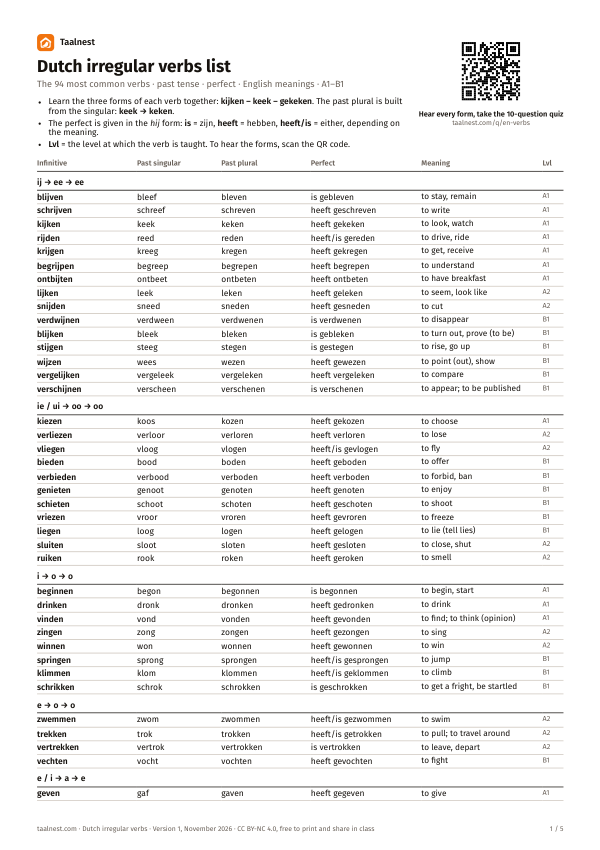
All 94 verbs on this page, with their English meanings, laid out for A4 paper. Exercises and an answer key come at the end; the QR code on the sheet brings you back to the listen buttons and the quiz on this page.
5 pages · A4 · prints in black and white · answer key on the last page
Free and licensed under CC BY-NC 4.0: print it and hand it out in lessons, courses and volunteer language coaching.
11 verbs to watch in the present tense
Nearly all irregular verbs are regular in the present tense: ik schrijf, jij schrijft, wij schrijven. A few have present forms of their own or a very short stem. You learn these in the first weeks of A1.
| Infinitive | ik | jij, u | hij, zij | wij, jullie, zij |
|---|---|---|---|---|
| zijn | ik ben | jij bent, u bent | hij is | wij zijn |
| hebben | ik heb | jij hebt, u hebt / heeft | hij heeft | wij hebben |
| kunnen | ik kan | jij kunt / kan | hij kan | wij kunnen |
| mogen | ik mag | jij mag | hij mag | wij mogen |
| willen | ik wil | jij wilt / wil | hij wil | wij willen |
| zullen | ik zal | jij zult / zal | hij zal | wij zullen |
| gaan | ik ga | jij gaat | hij gaat | wij gaan |
| doen | ik doe | jij doet | hij doet | wij doen |
| staan | ik sta | jij staat | hij staat | wij staan |
| zien | ik zie | jij ziet | hij ziet | wij zien |
| slaan | ik sla | jij slaat | hij slaat | wij slaan |
gaan, doen, staan, zien and slaan actually follow the rule; what makes them tricky is the short stem: ik ga, ik doe. When jij comes after the verb, the -t drops, and that rule is the same for every verb: Ga jij mee?, Kun je morgen komen?
Perfect tense: hebben or zijn?
The Dutch perfect is made with a conjugated auxiliary (hebben or zijn) and the participle at the end of the clause: Ik heb geschreven, Ik ben gebleven. English uses have for every verb (I have written, I have stayed), so the zijn-verbs are where English speakers go wrong. Most verbs take hebben. The ones that take zijn fall into three groups:
- Movement to a place: Ik ben naar huis gegaan. Hij is naar Utrecht gereden.
- Change of state: Ze is ziek geworden. De prijzen zijn gestegen. Mijn opa is gestorven.
- Staying and being: Ik ben thuis gebleven. Ik ben nog nooit in Groningen geweest.
Movement verbs such as lopen, fietsen, rijden and zwemmen take hebben when no destination is named and the sentence only says how long or how you moved: Wij hebben een uur gelopen, but Wij zijn naar het station gelopen. That is why most verbs marked heeft/is in the list can take either auxiliary. gaan, komen and vertrekken take zijn even without a destination: Ze is vertrokken.
Exceptions and traps
These are the forms that don't fit the patterns, or that learners trip over most often. The label shows the level at which each one is taught in the course.
A1zijn and hebben: completely different words in the past
The past of zijn is was/waren and its participle geweest; it fits no pattern at all. hebben has had/hadden and gehad. In the perfect each takes its own auxiliary: Ik ben ziek geweest, Ik heb griep gehad.
Gisteren was ik moe. Ik heb een drukke week gehad.
A1No ge- after an unstressed prefix
Verbs with one of the unstressed prefixes be-, ge-, her-, ont-, er- or ver- don't add ge- to the participle. That is why the participle sometimes looks exactly like the infinitive: vergeten → vergeten, ontvangen → ontvangen.
Ik heb het niet begrepen. Heb je mijn brief ontvangen?
A2Mixed verbs: vragen and lachen
vragen has an irregular past (vroeg) and a regular participle (gevraagd). lachen does the opposite: lachte, gelachen. These verbs sit halfway between regular and irregular, so they need learning separately.
Ze vroeg mijn naam. We hebben veel gelachen.
A2willen: two past forms
The past of willen can be wilde or wou. wilde is more common in writing; wou is often heard in speech. Both are correct.
Ik wilde je bellen. Ik wou je bellen.
A2Separable verbs follow their base verb
Verbs like opstaan, meenemen and aankomen follow the pattern of the base verb. In a main clause in the past tense, the prefix goes to the end of the clause; in the participle ge- goes in the middle: opstaan – stond op – opgestaan. English phrasal verbs work in a similar way (get up – got up), but the Dutch prefix moves right to the end.
Ik stond om zeven uur op. De trein is om tien uur aangekomen.
B1vergeten takes hebben or zijn
In the sense of 'it has slipped my mind, I can't remember', zijn is more usual; for leaving something behind somewhere, hebben is common too. Both auxiliaries are accepted.
Ik ben zijn naam vergeten. Ik heb mijn paraplu in de trein vergeten.
B1zullen has no participle
zullen is only used in the present and the past (zal, zou); like English shall and will, it has no perfect. zou is also the polite form for requests and wishes, much like English would.
Hij zou om acht uur komen. Zou u dat willen herhalen?
How can I tell if a verb is irregular?
- Is it on the list? The 94 verbs here are the irregular verbs you meet most in everyday Dutch. Less common ones such as bijten or zwijgen are not on it, so a verb missing from the list is not automatically regular.
- Look at the base verb. Take off a prefix such as ver-, be- or ont-, or a separable part such as op-, mee- or aan-: verkopen → kopen, meenemen → nemen. If the base verb is irregular, so is the whole verb.
- How does the participle end? Look the participle up in a dictionary. One ending in -en (gebleven) points to an irregular verb. One ending in -t or -d (gewerkt, gewoond) is usually regular, but check the past tense too: gedacht, gebracht and gevraagd belong to verbs with an irregular past.
- Don't go by the English verb. Related verbs don't always match: help and bake are regular in English, but Dutch has helpen – hielp – geholpen and bakken – bakte – gebakken.
- New and borrowed verbs are regular. mailen, appen, googelen and parkeren always take -te/-de: ik appte, ik heb geparkeerd.
The verb pages in the Taalnest dictionary show every form. On the page for gaan, for example, you'll find ging, gingen and ben gegaan in example sentences. For comparison, look at a regular verb such as werken or wonen.
How to memorise irregular verbs: five habits
- Say the three forms together, out loud. kijken – keek – gekeken. Learn the rhythm rather than single forms, the way you once learnt sing – sang – sung; the ear picks up a pattern before the eye does.
- Work group by group. Finish the ij → ee → ee group first: 15 verbs with a single rule. One group a day is enough.
- Learn the participle with its auxiliary. Not gebleven but is gebleven; not geschreven but heeft geschreven. That stops the hebben/zijn mistake before it starts, even when your English instinct says have.
- Make your own sentence for each verb. Gisteren heb ik een mail aan de school geschreven. A sentence from your own life stays with you far longer than a line in a list.
- Put the sheet where you'll see it. Print the PDF on this page and stick it on the fridge or next to your desk. Once a week, cover the columns on the right and say the forms from memory.
Compared with English: sing–sang–sung and a different perfect
English speakers start with a real advantage. Dutch and English are close relatives, and many irregular verbs come from the same roots and still change their vowel in a similar way: zingen – zong – gezongen is sing – sang – sung, drinken – dronk – gedronken is drink – drank – drunk, geven – gaf – gegeven is give – gave – given. The groups don't line up neatly, though, and some verbs are irregular in one language and regular in the other. The bigger difference is not in the forms but in how the two past tenses are used.
| English | Dutch | What's different |
|---|---|---|
| sing – sang – sung | zingen – zong – gezongen | Same family, but Dutch has o in both the past and the participle. |
| help – helped – helped | helpen – hielp – geholpen | Regular in English, irregular in Dutch. |
| I worked yesterday. | Ik heb gisteren gewerkt. | With a finished time like gisteren, Dutch happily uses the perfect; English can't say I have worked yesterday. |
| She has left. | Ze is vertrokken. | English always uses have. vertrekken, like gaan and komen, always takes zijn. |
| What did you do last night? | Wat heb je gisteravond gedaan? | A question about one finished event: simple past in English, perfect in Dutch. |
| When I was little, I walked to school every day. | Toen ik klein was, liep ik elke dag naar school. | Habits, background and stories: imperfectum, like the English simple past. |
This is almost the opposite of English. Because I have worked yesterday is wrong in English, English speakers tend to avoid the Dutch perfect and use the simple past for everything: Gisteren werkte ik. That sentence is correct, but in conversation it sounds like the start of a story. To simply report what you did, a Dutch speaker says Gisteren heb ik gewerkt.
A practical rule: in speech, use the perfectum for a single past event, even with gisteren, vorige week or in 2019. Use the imperfectum to tell a story or describe how things used to be, and for was, had and the modal verbs (kon, moest, wilde), which are common in speech too. In written stories the imperfectum is far more frequent. That is why you need both the past form and the participle of every irregular verb.
The most common mistakes English speakers make
Sarah heeft ook gekomen.Sarah is ook gekomen.English uses have for every perfect (Sarah has come too). komen always takes zijn in Dutch, like gaan, blijven and worden.
Ik heb gisteren naar de film gegaan.Ik ben gisteren naar de film gegaan.The perfect with gisteren is fine in Dutch, but movement to a place takes zijn: ben gegaan, never heb gegaan.
Ik wilde te komen, maar ik was ziek.Ik wilde komen, maar ik was ziek.English says wanted to come. After a modal verb (willen, kunnen, moeten, mogen, zullen) Dutch uses the bare infinitive, without te.
Gisteren ik ging naar de dokter.Gisteren ging ik naar de dokter.English keeps the subject first (Yesterday I went). In a Dutch main clause the verb comes second, so after gisteren it moves in front of the subject.
Ik heb tv gekijkt.Ik heb tv gekeken.kijken is in the ij → ee → ee group: the participle is gekeken. The regular ge-…-t pattern, the Dutch -ed, doesn't apply here.
Wij ging naar de markt.Wij gingen naar de markt.English went is the same for every person, but the Dutch past has a plural. With wij, jullie and zij add -en: ging → gingen.
Ik denkte dat het goed was.Ik dacht dat het goed was.denken is in the -cht group, just like think – thought: dacht, gedacht. There is no form denkte.
Ik sprok gisteren met de buurvrouw.Ik sprak gisteren met de buurvrouw.English spoke pulls learners towards o, but the Dutch past has a: sprak, spraken. The o only comes in the participle: gesproken.
Hij heeft ziek geworden.Hij is ziek geworden.worden (to become) describes a change of state and always takes zijn in the perfect.
Example sentences by level
A1
- Gisteren was ik thuis.I was at home yesterday.
- Emma heeft een broodje kaas gegeten.Emma ate a cheese sandwich.
- We zijn met de bus naar school gegaan.We went to school by bus.
- Heb je mijn bericht gezien?Have you seen my message?
A2
- Vorige week kreeg ik een brief van de gemeente.Last week I got a letter from the council.
- Mijn dochter is gisteren tien geworden.My daughter turned ten yesterday.
- We bleven thuis, want het regende.We stayed at home because it was raining.
- De trein vertrok om half negen.The train left at half past eight.
B1
- Het bleek dat de afspraak niet doorging.It turned out that the appointment wasn't going ahead.
- De huurprijzen zijn de laatste jaren sterk gestegen.Rents have risen sharply in recent years.
- Toen James naar Nederland kwam, sprak hij nog geen Nederlands.When James came to the Netherlands, he didn't speak any Dutch yet.
- Nadat Sarah haar baan had verloren, zocht ze maandenlang naar nieuw werk.After Sarah had lost her job, she spent months looking for new work.
Test yourself: 10 questions on irregular verbs
10 questions. After each answer you see a short explanation.
What is the past singular of blijven?
Show answer
Correct answer: bleef. blijven is in the ij → ee → ee group: bleef, plural bleven, participle gebleven. An irregular verb doesn't take -de in the past.
Gisteren ___ wij naar het strand. (gaan)
Show answer
Correct answer: gingen. The subject is plural (wij) and the sentence is in the past: ging becomes gingen in the plural.
Which is correct?
Show answer
Correct answer: Ik ben naar huis gefietst.. naar huis is a destination. When the place you reach is named, a movement verb takes zijn. Without a destination it takes hebben: Ik heb een uur gefietst.
What is the participle of kijken?
Show answer
Correct answer: gekeken. kijken – keek – gekeken. The participle of an irregular verb usually ends in -en.
Is Ik heb gisteren gewerkt correct Dutch?
Show answer
Correct answer: Yes, it is normal Dutch. Dutch uses the perfect for a finished past event, even with a time like gisteren (yesterday). I have worked yesterday is wrong in English, but that rule doesn't carry over.
Which is a mixed verb, with an irregular past tense and a regular participle?
Show answer
Correct answer: vragen. vragen – vroeg – gevraagd: the vowel changes in the past, but the participle ends in -d like a regular verb. lezen is irregular in both forms (las, gelezen), werken regular in both (werkte, gewerkt).
Hij ___ ziek geworden.
Show answer
Correct answer: is. worden describes a change of state and always takes zijn in the perfect.
What is the past tense of denken?
Show answer
Correct answer: dacht. denken is in the -cht group, like think – thought: dacht, dachten, gedacht.
What is the past singular of spreken?
Show answer
Correct answer: sprak. spreken – sprak – gesproken: the e → a → o pattern. English spoke suggests an o, but in Dutch the o only appears in the participle.
Wij ___ het antwoord niet. (weten, past tense)
Show answer
Correct answer: wisten. weten is fully irregular: wist, wisten, geweten.
Frequently asked questions
How many irregular verbs does Dutch have?
It depends on how you count. Including derived verbs such as verkopen or opstaan, there are many more; counting only base verbs, around 200. Everyday Dutch uses a small share of them: the 94 verbs here cover nearly all you need at A1 and A2, and the most frequent ones at B1.
Do I have to learn all the irregular verbs?
No. Start with the ones you use every day: zijn, hebben, gaan, komen, doen, zien and the modal verbs, then the rest of the A1 verbs. At A2 it makes sense to learn the verbs marked A1 and A2 in the list, and the ones marked B1 as you work towards the B1 exam. Many will look familiar from English, and learning them in groups makes the job smaller than it first seems.
Should I use the simple past (imperfectum) or the perfect (perfectum)?
In speech, for a single event, mostly the perfectum: Ik heb het gezien. That includes sentences with a finished time such as gisteren, where English would use the simple past. For a story, a situation in the past or a habit, use the imperfectum: Vroeger woonde ik in Manchester. was, had and the past of the modal verbs (kon, moest, wilde) are very common in speech too.
Can I use the PDF in my class or lessons?
Yes. The PDF is published under the Creative Commons CC BY-NC 4.0 licence: teachers, volunteer language coaches and language schools can print it and hand it out. On top of that, we allow you to hand it out in class in paid courses. The condition is that the Taalnest name and web address stay on it. Selling the PDF, or republishing it on another site as your own, is not allowed.
How can I learn to pronounce the forms?
Use the listen button next to each infinitive in the list: it reads the infinitive, the two past forms and the participle in turn. The QR code on the PDF brings you back to this page, so you can listen while you work through the sheet. Pay most attention to the vowels: Dutch ee and oo don't sound the way English spelling suggests, so bleef is nearer to safe than to leaf.
This rule in the course
You can practise this rule with exercises in these Taalnest lessons:
A2 · Theme 2: Customs, Weather and News
2.15 Saying What You Have Done: Irregular Verbs (Vertellen wat je gedaan hebt: onregelmatige werkwoorden)Open lesson
A2 · Theme 5: Study, Placement and Tests
5.5 Simple Past: Regular and Irregular (Verleden tijd: regelmatig en onregelmatig)Open lesson
After this topic
Related grammar topics
Example words for this rule
Your download has started
Practise the same topic in lessons with audio, and keep your progress in your account.
Create account